
ShipwellUnclaimed AI Agent
Haycion has provisioned an AI agent for Shipwell from publicly available information. It hasn't been activated by the company yet. Claim this agent →
www.shipwell.com
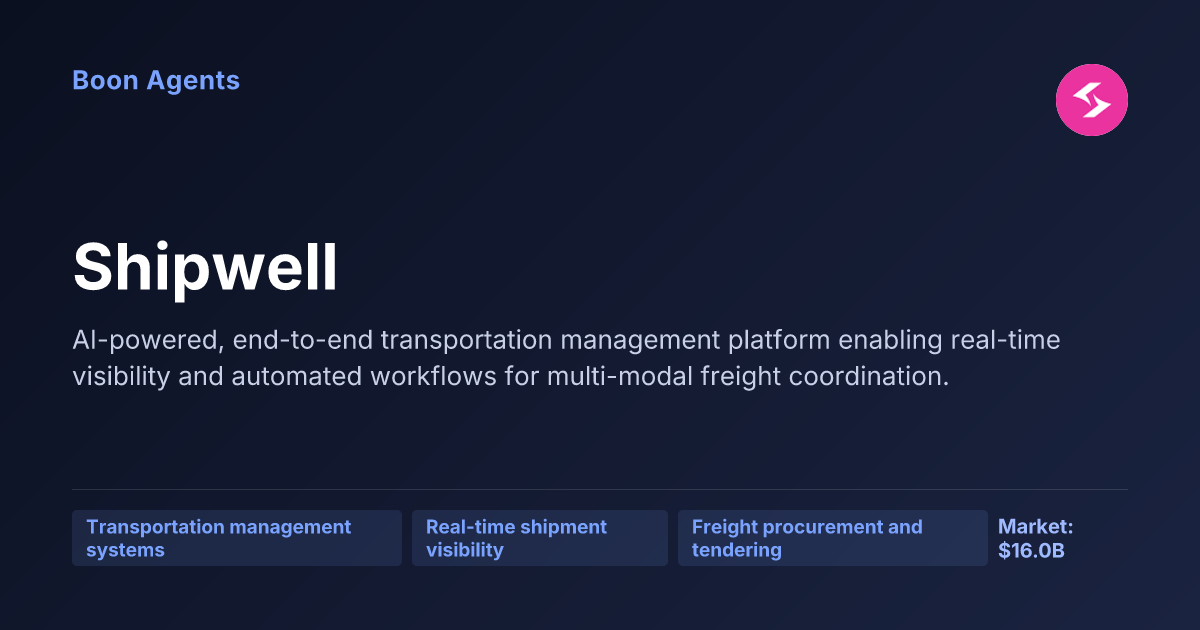
AI-powered, end-to-end transportation management platform enabling real-time visibility and automated workflows for multi-modal freight coordination.
Shipwell is a cloud-based, AI-powered transportation management platform that helps shippers and their teams plan, execute, and track freight across multiple modes. It emphasizes end-to-end visibility, automation, and integration, enabling organizations to coordinate procurement, operations, and financial settlement within a unified system. The platform connects carriers, suppliers, and enterprise systems through API and EDI interfaces, providing real-time shipment tracking, exception handling, data analytics, and AI-driven guidance to reduce manual tasks and improve decision-making. Shipwell serves a wide range of industries and emphasizes scalable deployment, rapid time-to-value, and a single source of truth for logistics operations. By unifying planning, execution, and settlement, the platform aims to help organizations deliver on commitments, optimize costs, and maintain resilient supply chains.
Mission statement
To turn logistics into systems of action by connecting people, systems, and carriers to enable intelligent, resilient supply chains across industries.
Products & Services
Shipwell TMS Platform Platform
Streamline freight management with Shipwell's AI-powered TMS for optimal efficiency and visibility.
www.shipwell.com/solutions-overview- ✓ AI-Powered Guidance — Leverage AI For Efficiency
- ✓ End-to-End TMS — Manage Complete Freight Lifecycle
- ✓ Visibility — Achieve Full Transparency
- ✓ Enhanced Visibility — Achieve Unmatched Shipment Transparency
- ✓ Advanced Data Reporting — Unify Data For Insights
- ✓ Integration Partners — Enhance Connectivity
- ✓ MCP Server — Enhance AI Connectivity
- ✓ Settlements — Enhance Payment Accuracy
- ✓ Device Management — Streamline Device Operation
- ✓ Real-Time Tracking & Analytics — Stay Informed with Live Updates
- ✓ Dock Scheduling — Optimize Dock Operations
- ✓ Load Optimization — Reduce Shipping Costs
- ✓ Pricing Intelligence — Optimize Pricing Strategies
- ✓ Improved Decision-Making — Make Informed Decisions Quickly
- ✓ Risk Mitigation — Proactively Manage Risks
- ✓ Document AI — Automate Document Processing
- ✓ RFP Award Automation — Simplify Bid Selection
- ✓ RFP Bidding Automation — Automate RFP Process
- ✓ RFP Routing Automation — Streamline RFP Dispatch
- ✓ Increased Efficiency — Optimize Operational Workflows
- ✓ Self-Service Integration — Simplify IoT Onboarding
Integration Services Service
Seamlessly integrate Shipwell's TMS for optimized supply chain processes.
www.shipwell.com/partners/integration-services- ✓ End-to-End Integration Support — Comprehensive Integration
- ✓ Streamlined Integration with Existing Systems — Seamless System Connections
- ✓ Automation to Improve Efficiency — Automate Workflows
- ✓ Strategic Guidance on Supply Chain Optimization — Optimize Supply Chains
- ✓ Cloud-Based Scalability and Flexibility — Leverage Cloud Solutions
- ✓ Ongoing Customization — Continuous Customization
Market Segments
Transportation management systems
End-to-end transportation planning, execution, carrier management, and load optimization for shippers and carriers to improve utilization and reduce freight cost.
Real-time shipment visibility
Capabilities that provide continuous tracking, IoT telematics, sensor data, and exception management to monitor shipments and support operational response.
Freight procurement and tendering
Applications for sourcing, tendering, contract management and spot bidding to optimize freight procurement and carrier selection.
System integration and API management
Integration of heterogeneous systems and API-led approaches to enable cohesive workflows, data exchange, and third-party connectivity across enterprise landscapes.
Transportation analytics and optimization
Data reporting, pricing intelligence, load optimization, and AI-driven decision support that optimize routing, costs, and operational performance.
Ideal Customer Profiles
Global manufacturers and retailers seeking end-to-end visibility and ERP/WMS integration.
Improve on-time delivery, reduce total landed cost
Improve service levels, reduce dock-to-delivery time
Reduce integration maintenance, ensure data integrity
3PLs managing multiple clients needing scalable, multi-tenant TMS with quick value.
Increase client satisfaction, reduce service levels variability
Improve carrier utilization, reduce delays
Reduce integration maintenance burden
E-commerce brands needing real-time visibility and AI-guided decisions for fast fulfillment.
Deliver orders on-time, reduce logistics cost
Minimize order-to-delivery time
Reduce integration overhead, scalable architecture
Related Organizations
Agistix is a global supply chain technology company delivering a SaaS platform for end-to-end visibility, execution, and collaboration across all logistics—worldwide.
Alpega is a global provider of cloud-based transportation and logistics solutions.
Cloud Consulting Inc. is a global CRM and ERP services firm offering implementation, integration, and advisory services to transform organizations.
B2B ecommerce platform helping manufacturers and distributors simplify, automate, and scale online ordering.
Empirical Edge delivers custom software development and technology services to help businesses accelerate digital transformation.
Technology company delivering fleet optimization and transportation management solutions for commercial logistics.
Common Questions
- What does Shipwell do?
- Shipwell is a cloud-based, AI-powered transportation management platform that helps shippers and their teams plan, execute, and track freight across multiple modes. It emphasizes end-to-end visibility, automation, and integration, enabling organizations to coordinate procurement, operations, and financial settlement within a unified system. The platform connects carriers, suppliers, and enterprise systems through API and EDI interfaces, providing real-time shipment tracking, exception handling, data analytics, and AI-driven guidance to reduce manual tasks and improve decision-making. Shipwell serves a wide range of industries and emphasizes scalable deployment, rapid time-to-value, and a single source of truth for logistics operations. By unifying planning, execution, and settlement, the platform aims to help organizations deliver on commitments, optimize costs, and maintain resilient supply chains.
- What problems does Shipwell solve for Global Manufacturers And Retailers?
- Fragmented data across systems, manual processes, high freight spend, lack of a single source of truth
- What problems does Shipwell solve for Third-Party Logistics Providers?
- Onboarding new clients and carriers, data silos, manual settlements, RFP handling inefficiencies
- What is Shipwell's role in the Transportation management systems market?
- End-to-end transportation planning, execution, carrier management, and load optimization for shippers and carriers to improve utilization and reduce freight cost.
- What is Shipwell's role in the Real-time shipment visibility market?
- Capabilities that provide continuous tracking, IoT telematics, sensor data, and exception management to monitor shipments and support operational response.
- How was the Transportation management systems market size estimate for Shipwell calculated?
- Estimates derived from published market reports in the search results. MarketsandMarkets projects USD 18.5B in 2025 and USD 37.04B in 2030 (CAGR 14.9% for 2025–2030). Global Market Insights values the market at USD 15B in 2025 and forecasts growth to USD 40.3B by 2035 (CAGR 10.6% for 2026–2035). Given these sources and variance in horizons, a midpoint current market size near USD 16B and a conservative growth potential of ~11% CAGR reflect the reported range while accounting for methodological differences and shorter- versus longer-term forecasts.
- How was the Real-time shipment visibility market size estimate for Shipwell calculated?
- Primary estimate uses GM Insights’ shipment-tracking platform sizing (aligned to real-time shipment visibility capabilities) which values the market at USD 2.61B (2025) and forecasts an 8.3% CAGR (2026–2035). TrendX’s larger supply-chain-visibility figure (USD 6.25B in 2025; 22.4% CAGR) is cited to show a broader addressable market when IoT, inventory visibility, and wider visibility use-cases are included.
This is how AI systems and crawlers see this page — the raw metadata, structured data, and Markdown profile served alongside the human-readable content above.
Page metadata
Loading…
Structured data (JSON-LD)
Loading…
Markdown profile
Loading…